


The Palestinian Keffiyeh: Pattern, Heritage, and the Last Hirbawi Loom

TL;DR
The Palestinian keffiyeh (كوفية) is a checkered cotton headscarf that became a symbol of Palestinian national identity during the 1936 to 1939 Arab Revolt against British rule. The black-and-white version is produced worldwide, but the last Palestinian-owned keffiyeh factory is the Hirbawi factory in Hebron, weaving since 1961. Yasser Arafat carried it to a global audience from 1969 onward. FALASTIN sources its keffiyehs from Hirbawi.
The keffiyeh sits at the center of FALASTIN's Symbols of Palestine T-Shirts collection, the same way it sits at the center of how Palestinians are seen. Inside a small workshop on the southern edge of Hebron, a loom built in the 1960s is still weaving the cloth the way it has been woven for over half a century. The Hirbawi factory is now the last place in Palestine producing a Palestinian-made keffiyeh. Most keffiyehs sold in the world today, including many of those worn at solidarity marches, are mass-produced abroad, a large share of them in Chinese mills.
This is the story of the cloth itself: where the patterns came from, what they mean, why the colors differ, and how a humble agricultural headwear became one of the most recognized symbols on earth.
A Cloth Older Than the Nation
Long before the keffiyeh became a symbol, it was a tool. Bedouin and Levantine fellahin (peasant farmers) wore it to keep the sun off their heads, the dust out of their mouths, and the wind off their necks. The cotton was light, the weave was breathable, and the cloth wrapped easily into a turban or fell straight as a hood. The keffiyeh existed in some form across the entire Arab world long before any of the modern countries did.
What made the Palestinian keffiyeh distinctive was the pattern, the colors, and the way it became, in the twentieth century, attached to a specific people.
The Patterns and What They Mean
Three motifs run through the classic Palestinian keffiyeh weave. The fishnet, a diagonal cross-hatched grid, is read as a reference to the Mediterranean and the Palestinian fishing tradition along the coast. The olive leaves, woven as small repeated branches, are read as a reference to the inland orchards and the rooted Palestinian agricultural life. The bold zigzag border stitches the two together, sometimes interpreted as the trade routes that connected coast and hill country, sometimes as the lines of Palestinian villages.
None of these meanings are written down in a single canonical document. They are oral, accumulated, contested in some details, and broadly accepted in their outlines. The keffiyeh, like the Palestinian key, is a symbol whose meaning has been handed down rather than authored. The way the cloth is folded and worn carries its own vocabulary, traced in our guide to how to wear a keffiyeh.

Black-and-White vs Red-and-White
The most recognizable keffiyeh in the world is the Palestinian black-and-white. It is the version Yasser Arafat wore for fifty years; the version that shows up on protest banners; the version most people picture when they hear the word.
The red-and-white keffiyeh, also widely worn across the Levant, is associated more with Jordan and the Gulf states. The colors are not strict signifiers of nationality, and there is overlap, but to a Palestinian eye the black-and-white reads as the home version. In some accounts, the red-and-white was popularized by Jordanian Bedouin tribes and entered British military supply during the Mandate. The black-and-white stayed with the Palestinian fellahin.
The 1936 Revolt and the Keffiyeh as a National Symbol
Before 1936, the keffiyeh in Palestine was rural. It was what farmers wore. City men, especially in Jerusalem, Jaffa, and Haifa, wore the tarbush (the red felt fez) under the late Ottoman and early Mandate eras.
The shift came during the Arab Revolt of 1936 to 1939, the three-year Palestinian uprising against British colonial rule. The revolt was organized largely from the rural areas, and rebel fighters wrapped their faces in the keffiyeh both for warmth and to hide their identities from British troops. To make it harder for the British to single out the rebels, the urban leadership of the revolt, especially in Nablus, called on city Palestinians to also wear the keffiyeh in solidarity. Within weeks, the rural cloth had become the national cloth. According to Middle East Eye, this was the moment Palestinians across class lines adopted the fabric as a shared sign of identity. After the revolt ended, the symbolism stayed.
How Did the Palestinian Keffiyeh Become a Global Symbol?
The cloth left Palestine on the heads of its most photographed figures. From 1969, when he became chairman of the Palestine Liberation Organization, Yasser Arafat wore the keffiyeh in public almost every day for the rest of his life. He arranged it so the long end fell over his right shoulder alone, and many Palestinians read the shape it made as the map of historic Palestine. It was on his head when he addressed the United Nations General Assembly in 1974. Over three decades, the black-and-white checks became visual shorthand for the Palestinian cause itself.
Arafat was not the only figure who carried it. Leila Khaled, a member of the Popular Front for the Liberation of Palestine, was widely photographed around 1969 and 1970 wearing the keffiyeh as a headscarf, among the first images to attach the cloth to a Palestinian woman rather than a male fighter. Through the following decades the keffiyeh traveled further than any Palestinian passport, worn at demonstrations from Montreal to Santiago.
By the mid-2000s, Western fashion labels were selling keffiyeh-print scarves stripped of their meaning, a wave of borrowing that drew criticism for treating a symbol of a displaced people as a seasonal print. The controversy had an unintended effect. It pushed diaspora communities and solidarity activists to seek out the authentic, Palestinian-woven cloth, which meant seeking out the one factory still making it.
The Hirbawi Factory
The Hirbawi factory was founded in 1961 by Yasser Hirbawi in Hebron, using mechanical looms he brought in from Japan and adapted to the traditional keffiyeh weave. For decades his looms ran long hours, at their peak around fifteen machines producing the cloth that went to Jerusalem, Amman, Beirut, and through trade to the rest of the world. Hebron, a craft city for centuries, known for its glass-blowing, ceramics, and stone, suited the work.
By the early 2000s, cheap Chinese imports had taken almost the entire global keffiyeh market. The Hirbawi factory nearly closed, its output collapsing and most of its looms falling silent. It was kept alive by a renewed wave of demand from solidarity activists, diaspora communities selling the cloth online, and the family's refusal to let the looms stop. Yasser Hirbawi died in 2018, and the factory is now run by his three sons, who maintain the original machines and weave the same fishnet, olive-leaf, and zigzag patterns. As The National documented, only a handful of the original looms still run today. It remains the only place making the Palestinian keffiyeh in Palestine.
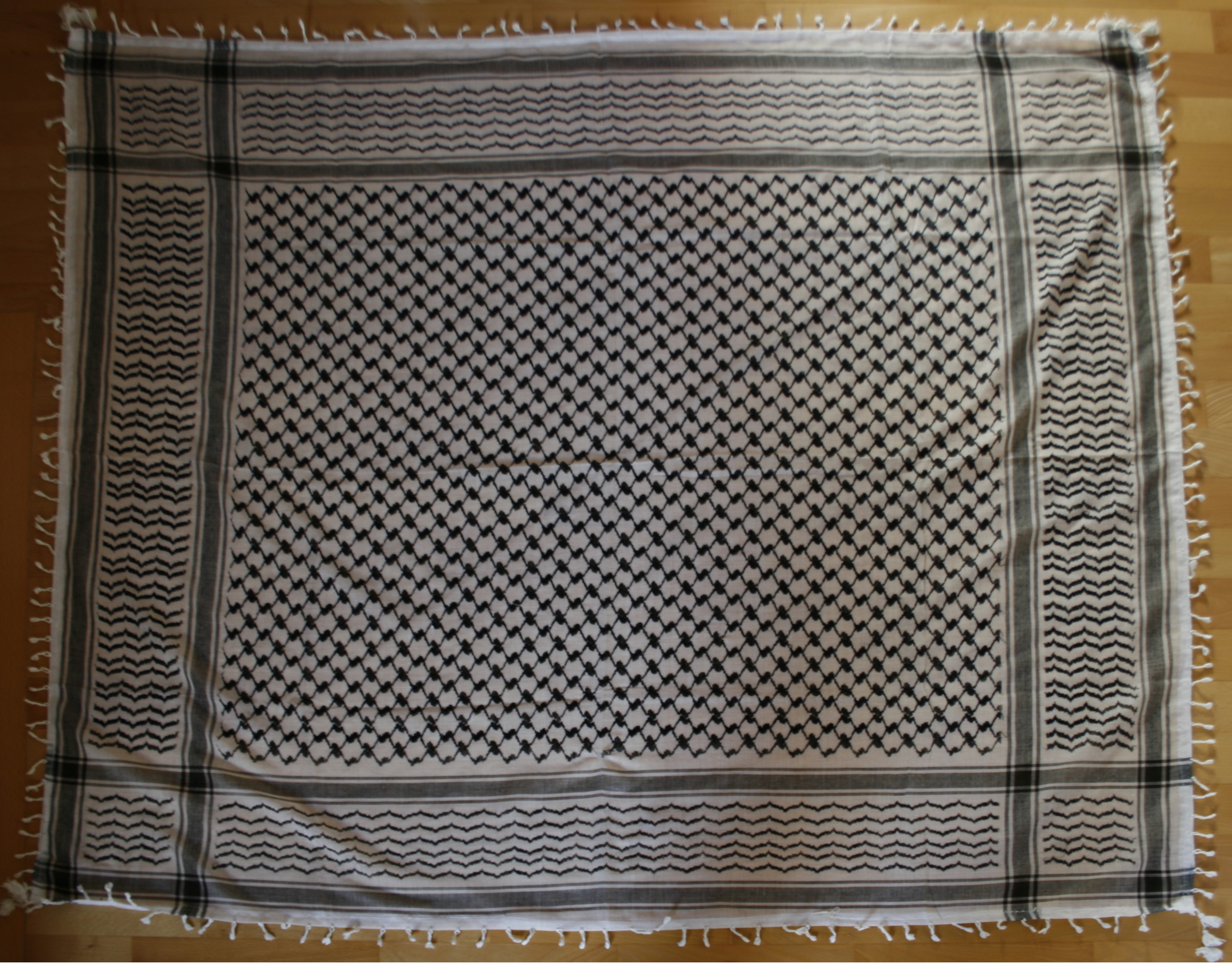
For deeper reading, the Wikipedia entry on the keffiyeh has a dedicated section on the Hirbawi factory and the patterns, and the Institute for Palestine Studies holds academic context on the keffiyeh's role in twentieth-century Palestine. The story of the Palestinian orange sits in the same archive of Palestinian symbols carried forward by ordinary objects.
Frequently Asked Questions
What is the Palestinian keffiyeh?
The keffiyeh is a checkered cotton headscarf traditionally worn by Palestinian farmers and workers. The black-and-white pattern became a symbol of Palestinian national identity during the 1936 Arab Revolt. It was popularized internationally by PLO leader Yasser Arafat, who wore it consistently from 1969 onward. Today it is worn as a symbol of Palestinian solidarity worldwide.
What is the Hirbawi factory?
The Hirbawi factory in Hebron is the last Palestinian-owned keffiyeh manufacturer in the Palestinian territories. It has produced keffiyehs continuously since 1961. The factory survived competition from cheaper Chinese-manufactured imitations and remains the only producer of authentic Palestinian-made keffiyehs. Supporting Hirbawi is frequently cited as a way to ensure economic benefit reaches Palestinian producers directly.
How did the keffiyeh become a global symbol?
The keffiyeh moved from rural Palestinian dress to national symbol during the 1936 to 1939 Arab Revolt, then to a global one through its most photographed wearers. Yasser Arafat wore it daily from 1969 and at the United Nations in 1974, and PFLP figure Leila Khaled was widely photographed in it around 1969 and 1970. By the 2000s it was recognized worldwide as a sign of Palestinian solidarity.
What does the keffiyeh pattern mean?
The black-and-white fishnet and chain pattern of the Palestinian keffiyeh is said to represent Palestinian fishing nets and trade routes, though these attributions are primarily symbolic rather than documented historical fact. What is documented is the pattern's association with Palestinian nationalist identity since the 1936 revolt and its evolution into one of the most recognized symbols globally by the 1970s.

At FALASTIN, we aim to keep that heritage alive through our Symbols of Palestine T-Shirts.
100% of profits from FALASTIN are donated to the United Palestinian Appeal.