


Hebron (Al-Khalil): Palestine's Oldest City
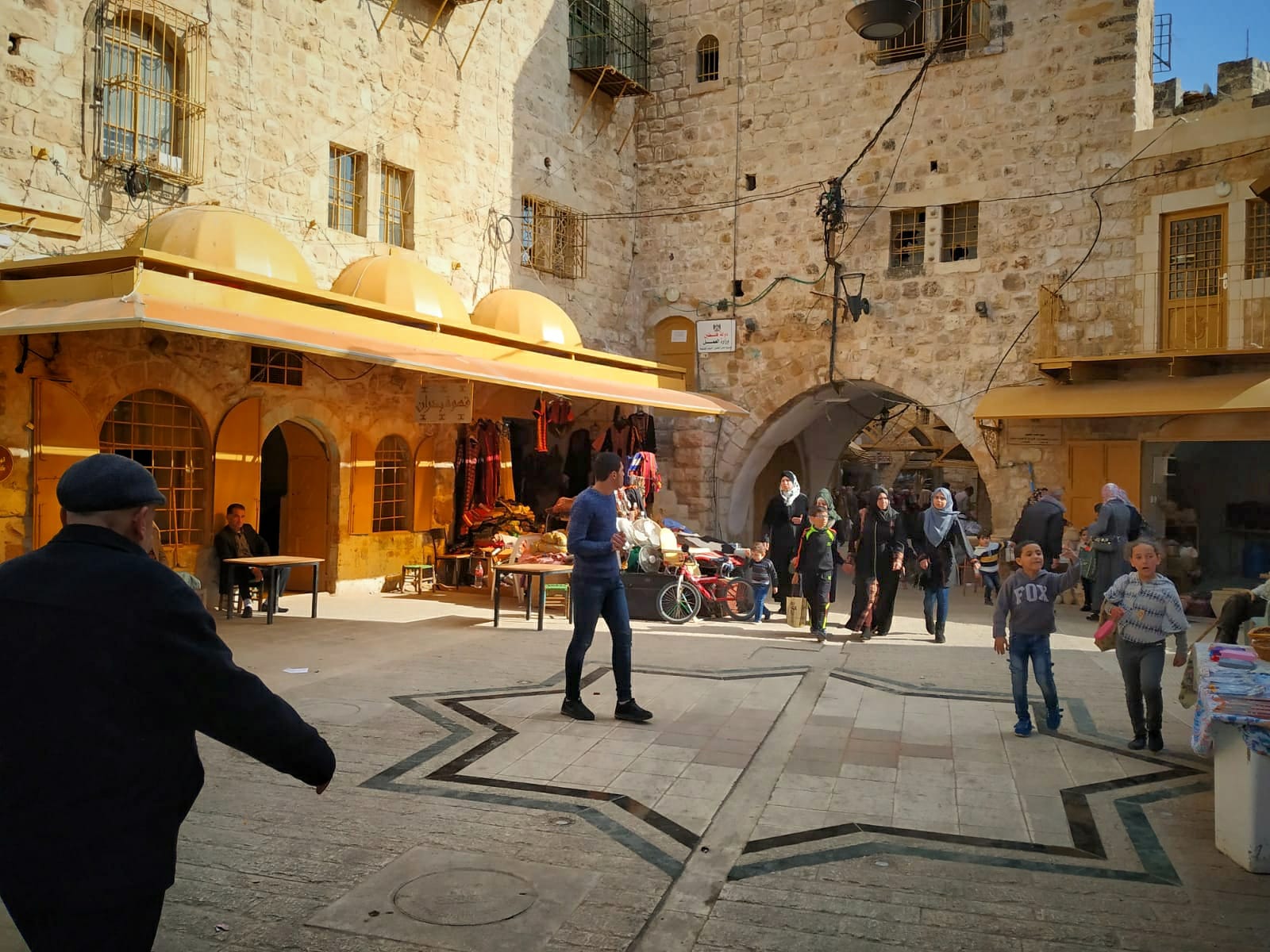
Hebron (Al-Khalil): The Oldest Continuously Inhabited City in Palestine
Al-Khalil (الخليل), "the friend," is what Palestinians have always called Hebron. The name is a direct reference to the Prophet Ibrahim (Abraham), whom the Quran addresses as Khalil Allah, the friend of God. He is said to be buried here, beneath the stones of a city that has not stopped breathing for four thousand years.
Hebron (Arabic: Al-Khalil) sits at roughly 930 metres above sea level in the southern West Bank, one of the highest cities in Palestine. Population: approximately 215,000 Palestinians (2017 census). Its old city was inscribed on the UNESCO World Heritage List (in danger) in 2017. The city is home to the Ibrahimi Mosque (Cave of Machpelah), sacred to Judaism, Christianity, and Islam. Hebron is the only Palestinian city with a surviving traditional glass-blowing industry, and its embroidery is distinguished by a deep, saturated red palette unique in the region.
Origins: Four Thousand Years of Continuity
Hebron's recorded history stretches back to the Bronze Age. The city appears in texts as Kirjath Arba, "City of Four," before acquiring its Arabic name. During the Ottoman period, it served as a major commercial hub for the southern Levant, trading in glass, grapes, leather, and textiles across a network that reached Cairo and Damascus. By the nineteenth century it had become one of the most economically active cities in the region.
Hebron sits on a limestone ridge at the southern end of the Judean Hills. Its elevation, roughly 930 metres, gave the city a cooler summer climate than the coastal plain, and the surrounding land proved fertile enough to sustain viticulture and olive cultivation across millennia. The vineyards around Hebron remain among the oldest continuously farmed plots in Palestine.
The events of 1948 changed Hebron's boundaries but not its continuity. Unlike Haifa, which was depopulated by displacement (read more about Haifa), Hebron's Palestinian population was not expelled. It remained, absorbed the weight of successive administrations, and endured.
The Ibrahimi Mosque (Cave of Machpelah)
At the centre of the old city stands a structure that belongs, in different traditions, to three faiths simultaneously. The Ibrahimi Mosque, known in Jewish tradition as the Cave of Machpelah, is built over a cave that Genesis identifies as the burial place of Abraham, Sarah, Isaac, Rebecca, Jacob, and Leah. Islamic tradition adds Joseph to that list.
The outer walls of the complex date to the Herodian period, roughly the first century BCE. The Crusaders built a church over it in the twelfth century. The Mamluks converted it into a mosque in 1266. The building has never stopped serving as a place of prayer.
On 25 February 1994, an American-Israeli settler named Baruch Goldstein entered the mosque during Fajr prayer and opened fire on the congregation. 29 Palestinian Muslims were killed; more than 125 were wounded. The massacre altered the social geography of Hebron permanently. It accelerated the partitioning of the city and shaped the terms of the 1997 Hebron Agreement, which divided the old city into H1 (under Palestinian Authority control) and H2 (under Israeli military control). Approximately 35,000 Palestinians live in H2 alongside roughly 800 Israeli settlers.
The mosque endures. Five daily prayers continue without interruption.
Hebron Glass: The Only Surviving Glass-Blowing Tradition in Palestine

Hebron's glass industry dates to the Roman period. For two thousand years, artisans here have worked sand and ash into vessels; the characteristic blue-green finish is a result of mineral impurities that glassmakers in Hebron learned to cultivate rather than eliminate.
Today, Hebron is the only Palestinian city with a surviving traditional glass-blowing industry. A small number of workshops in the old city and its outskirts continue to produce hand-blown bottles, vases, and decorative pieces using methods that have not fundamentally changed in centuries. The glass is recycled: broken pieces melted down alongside raw materials, a practice that was pragmatic long before it became fashionable.
The deep cobalt blue and forest green of Hebron glass are not decorative choices imposed from outside. They are the inherited signature of a particular place: this limestone, this sand, these artisans. Nowhere else in the Palestinian territories produces them.
Hebron Embroidery: A Deeper Red
Palestinian embroidery is regional in the most precise sense. The stitches used in Ramallah are not the same as those from Bethlehem, and neither looks like what comes from the villages around Hebron. For a fuller picture of how tatreez patterns by region differ across Palestine, the distinctions run deep enough to function as geographic identity.
The Hebron palette is its most immediately recognisable feature: a deeper, darker red, closer to burgundy or oxblood than the pinks and magentas that characterise Bethlehem and central West Bank work. The geometric density is also higher, with patterns tending toward compact, interlocking forms rather than the airier arrangements seen farther north. To understand the full range of Palestinian embroidery patterns and tatreez designs, Hebron's distinctive palette is one of the most striking regional variations.
Tatreez (تطريز) from the Hebron district was produced primarily in the southern West Bank villages, Dura, Yatta, Samu, Beit Kahil, rather than in the city centre itself. Village women embroidered dresses as part of a tradition that documented local identity in thread. Each dress carried the maker's place of origin as plainly as any written record.
That tradition has not disappeared. It has contracted, and the contexts that sustained it (village life, seasonal ceremony, communal dress) have been fractured by decades of displacement and economic pressure. But the women who carry it forward are not preserving a museum piece. They are continuing a practice.
Modern Hebron
With a population of approximately 215,000, Hebron is the largest city in the West Bank. It is also the most economically active, home to a significant share of Palestinian manufacturing, including furniture, shoes, food processing, and stone cutting. The stone quarried in the hills around Hebron, a pale limestone that ages to honey-gold in sunlight, has been used to build Palestinian homes and Israeli settlements simultaneously, a fact the city lives with without resolution.
The old city, inscribed as a UNESCO World Heritage Site (in danger) in 2017, has suffered systematic deterioration in H2. Shops that once lined the main market street were shuttered following the imposition of movement restrictions. Buildings have fallen into disrepair. But the designation brought international attention to an architectural heritage, the Ottoman-period stone market, the medieval khans, the Mamluk-era structures, that would otherwise receive none. Like Nablus, whose old city carries its own layers of Ottoman architecture and living craft traditions, Hebron's historic core represents a Palestinian urban heritage under acute pressure.
Al-Khalil does not invite pity. It is still a city where people live, argue, cook, study, and build. Its glass workshops are still lit. Its embroiderers still thread needles. Its market still moves.

Hebron is not just a city with a complicated present; it is a living testament to what Palestinians have built and sustained across centuries of continuous habitation: in craft, in faith, in stone, and in thread.
Frequently Asked Questions
- Why is Hebron important to Palestinians?
- Hebron (Al-Khalil) is the largest city in the West Bank and one of the oldest continuously inhabited cities in Palestine. It is home to the Ibrahimi Mosque, a site of profound religious significance to Muslims. The city is also a centre of Palestinian commerce, craftsmanship, and cultural identity; its glass-blowing and embroidery traditions are among the most distinctive in the region. The old city was inscribed on the UNESCO World Heritage List (in danger) in 2017 in recognition of its historical and architectural significance.
- What is Hebron famous for?
- Hebron is famous for the Ibrahimi Mosque (Cave of Machpelah), which is sacred to Judaism, Christianity, and Islam and is believed to contain the tombs of Abraham, Isaac, Rebecca, Jacob, and Leah. The city is also known for its traditional glass-blowing industry, the only one surviving in the Palestinian territories, which produces characteristic blue and green glass pieces dating back to the Roman period. Hebron's embroidery, marked by a deep burgundy-red palette and dense geometric patterns, is another defining product of the region.
- What is unique about Hebron embroidery?
- Hebron embroidery is distinguished primarily by its colour palette: a deep, dark red, closer to burgundy or oxblood, that differs markedly from the brighter pinks and magentas of Bethlehem and Ramallah work. The geometric density is also higher, with tightly interlocking patterns. The tradition originates in the southern West Bank villages around Hebron, including Dura, Yatta, and Samu, where women embroidered dresses as a form of regional identity, encoding their place of origin in the stitching.
At FALASTIN, we aim to keep that heritage alive through our Palestinian Clothing collection, pieces rooted in the embroidery traditions, patterns, and regional identity that cities like Al-Khalil have carried forward for generations.
100% of profits from FALASTIN are donated to the United Palestinian Appeal.