


Akka (Acre): 4,000 Years of Palestinian History

عكا (Akka, also known as Acre) stands at the edge of the Mediterranean like a city that has refused, across four thousand years of continuous habitation, to be erased from the map of the world. Perched on a promontory where the coastal plain of what is now northern Palestine meets the sea, Akka is among the oldest continuously inhabited cities on earth: Phoenician traders anchored here, Egyptian pharaohs recorded it in stone, Alexander the Great passed through its gates, and Crusader knights raised some of the most formidable fortifications in the medieval world within its walls. Long before any of them arrived, it was already old.
This is the story of the northernmost coastal city of historic Palestine, and what fifty centuries of layered civilization left behind. At FALASTIN, the city's patience with stone and time is part of why our Palestinian Clothing collection exists: heritage you can wear, made deliberately, rooted in place.
Four Thousand Years of Akka
TL;DR
Akka (Arabic: عكا, also known by its Crusader name Acre) is one of the oldest continuously inhabited cities in the world, with documented settlement stretching back over 4,000 years. Located on a promontory on the northern coast of Palestine, it was the most important port city in the eastern Mediterranean during the Crusader period (12th to 13th centuries). The Crusader-era tunnels, vaults, and sea walls survive largely intact beneath and within the modern city. In the Ottoman period (16th to 19th centuries), Akka was rebuilt as a regional capital under Governor Ahmad al-Jazzar. The city's Palestinian population before 1948 was approximately 13,000; during the Nakba, the majority were displaced. A Palestinian Arab community of approximately 33,000 remains today, alongside a Jewish population, in a city designated as a UNESCO World Heritage Site in 2001.
Akka was already an old city when the Bronze Age ended. Phoenician traders ran cedar and copper out of the harbor in the second millennium BCE. The Romans called the city Ptolemais and used it as a forward port for their eastern campaigns. In 1104, the Crusaders captured Akka and held it for nearly two centuries, making it the most important port of the Crusader Kingdom of Jerusalem. After the fall of Jerusalem in 1187, Akka briefly became the Crusaders' last capital in the Levant.
The Mamluk sultan al-Ashraf Khalil retook the city in 1291, ending the Crusader era. Under the Mamluks and then the Ottomans, Akka rebuilt itself, layer over layer, on top of its own ruins. The streets you walk in the old city today follow the alignments of buildings from four different empires.

The Old City Inside the Walls
The walls of Akka enclose one of the most intact Ottoman old cities in the eastern Mediterranean. The Citadel, built by Ahmad Pasha al-Jazzar in the late eighteenth century, sits over a labyrinth of underground Crusader halls that were lost for five hundred years and rediscovered in the twentieth. The Al-Jazzar Mosque, completed in 1781, is one of the largest Ottoman mosques in Palestine, with a minaret that rises clean over the rooftops.
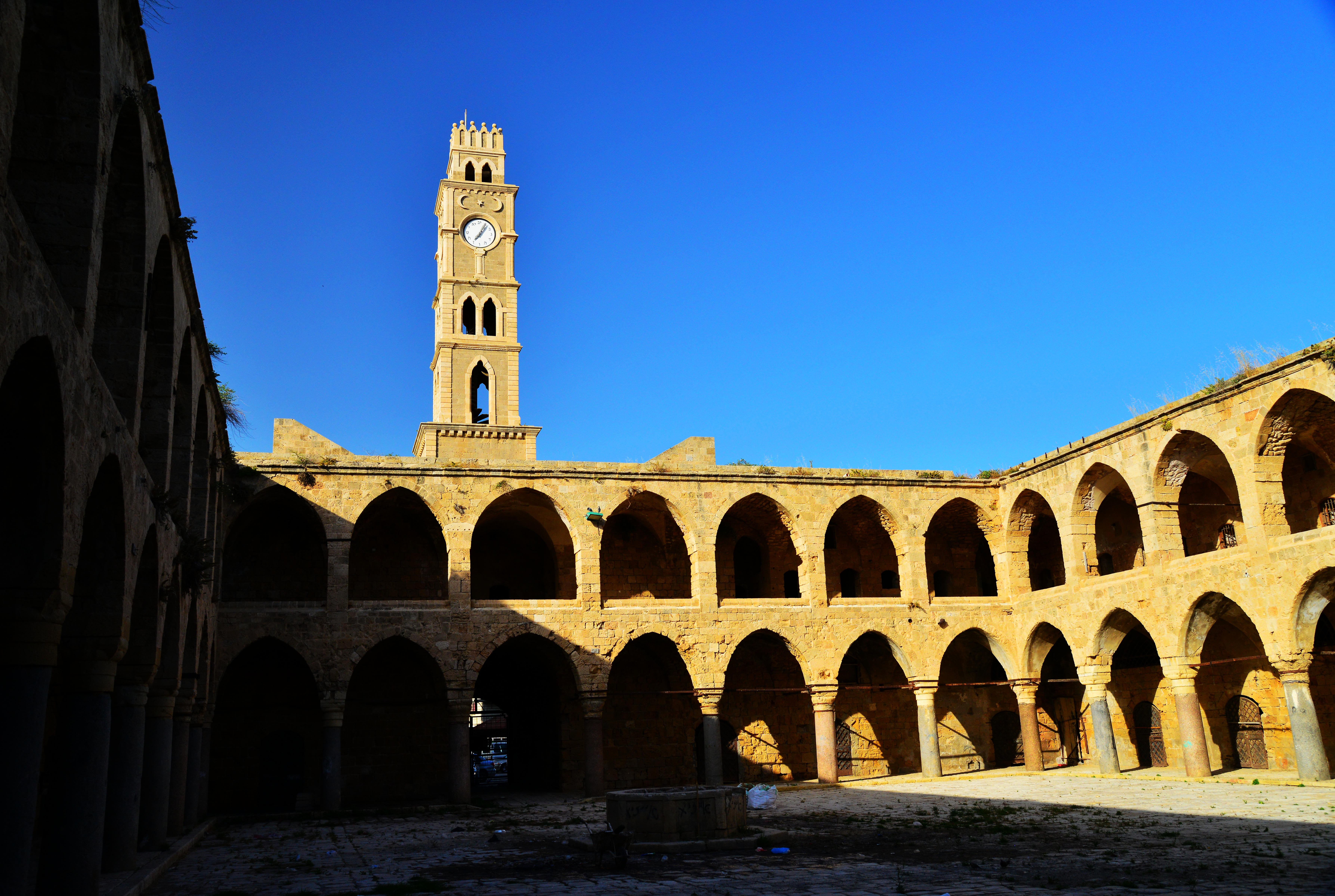
The souks, the public baths (Hammam al-Pasha), and the caravanserais all date from the same period of Ottoman ambition. Khan al-Umdan, the "Caravanserai of the Pillars," is the largest and most famous of them, with a clock tower added in the 1900s and granite columns reused from earlier Crusader churches.
Akka in the Late Ottoman and Mandate Eras
In 1799, Napoleon Bonaparte besieged Akka for two months and failed to take it. The siege was one of his only major defeats, and the city's reputation as the gateway that stopped a French invasion of the Ottoman Empire was earned in those two months. Ahmad Pasha al-Jazzar, the Ottoman governor who held the walls, became one of the most controversial figures in late Ottoman history: a brutal ruler who nonetheless saved the city from foreign occupation.
Through the nineteenth century and into the British Mandate, Akka remained a working port and a mixed Palestinian city: Muslims, Christians, and a small Jewish community sharing the souks and the alleys inside the walls. By 1947, the Palestinian population of Akka was around 17,000. The coastal soil surrounding Akka was among the most productive in historic Palestine, giving rise to groves that became synonymous with the Palestinian Orange, a fruit the world came to associate with Palestinian abundance.
April 1948
Akka fell in the same coastal collapse that took Haifa and Jaffa. By April 1948, refugees from villages further south had flooded the city, and a typhoid outbreak ran through the overcrowded old quarters. On May 17, 1948, after a brief siege, the city surrendered. Most of its Palestinian population fled north to Lebanon by sea, the same way the Palestinians of Haifa had three weeks earlier.
Within months, Akka's Palestinian population had collapsed to a few thousand, almost all of whom remained inside the old city. The neighborhoods outside the walls were emptied, then resettled by new arrivals.
Akka Today
The old city of Akka was inscribed as a UNESCO World Heritage Site in 2001, recognized for its layered preservation of Crusader, Mamluk, and Ottoman architecture. Inside the walls, a Palestinian community of around 5,000 still lives, fishes, and runs the souks. The fishing harbor is small now, but it is the same harbor the Crusaders dredged.
The coastal cities each carry their own version of 1948. Jaffa fell in May. Haifa fell in April. Akka fell between them. The story of the olive groves around Akka is told in The Palestinian Olive Tree. For deeper reading, the Palestine Remembered Akka archive and the Institute for Palestine Studies are starting points.

Frequently Asked Questions
Why is Akka historically significant?
Akka (Acre) is historically significant as the last major Crusader stronghold in the eastern Mediterranean, falling in 1291 and ending the Crusader era; as a major Ottoman port city rebuilt by Ahmad al-Jazzar in the 18th century; and as a Palestinian Arab city with over 4,000 years of continuous habitation, now a UNESCO World Heritage Site.
What happened to Akka in 1948?
In May 1948, Akka came under Israeli military control; most of the city's Palestinian Arab population of approximately 13,000 was displaced during the Nakba; approximately 3,000 Palestinians remained and were confined to a small area; the city was subsequently repopulated with Jewish residents; a Palestinian Arab community of approximately 33,000 remains in Akka today.
Is Akka the same as Acre?
Yes. Akka is the Arabic name for the city known in English as Acre, in Hebrew as Akko, and in French as Saint-Jean d'Acre during the Crusader period. The city has been known by these variations across different periods of its 4,000-year history. The Arabic name Akka (عكا) is the form used in Palestinian tradition and in this article.
At FALASTIN, we aim to keep that heritage alive through our Palestinian Clothing.
100% of profits from FALASTIN are donated to the United Palestinian Appeal.