


The Palestinian Sunbird: Palestine's National Bird and Its Meaning
High in an orchard outside Jericho, a bird barely larger than a thumb catches the sun and turns, for a moment, into a fleck of moving metal. This is the Palestinian sunbird, also written as the Palestine sunbird, the small nectar-feeder that science calls Cinnyris osea. Its back and throat burn iridescent blue and green in direct light, then fall to near black when the bird shifts a few degrees. For a creature that weighs only about seven or eight grams, it carries a remarkable amount of meaning.
Known in Arabic as tair al-shams al-filastini (طائر الشمس الفلسطيني), the sunbird belongs to the family Nectariniidae, the Old World birds often compared to the hummingbirds of the Americas. It was long classified as Nectarinia osea before ornithologists moved it to the genus Cinnyris. The bird has been widely described as the national bird of Palestine, and it now sits alongside the olive branch, the key, and the poppy among the symbols worn across Palestinian heritage clothing.

TL;DR
The Palestine sunbird (Cinnyris osea) is a small iridescent nectar-feeding bird native to the eastern Mediterranean, including historic Palestine. The breeding male shows glossy blue and green plumage with orange tufts at the breast; the female is a quieter grey-brown. The bird has been widely described as the national bird of Palestine, and in 2015 the Palestinian Authority adopted it as a national bird. Its rootedness in the land, its resilience, and its refusal to leave have made it a quiet emblem of belonging for Palestinians.
A small bird built for nectar
The Palestine sunbird is tiny. It measures roughly 8 to 12 centimeters from bill to tail and weighs between about seven and eight grams. The breeding male is the one most people picture: glossy iridescent blue and green across the head, throat, and back, with small orange tufts at the sides of the breast that give the species its other common name, the northern orange-tufted sunbird. The female and the non-breeding male are quieter, grey-brown above and pale below.
Both sexes share a long, slender, downward-curving black bill and a brush-tipped tongue, tools shaped for a single job: reaching deep into a flower and drawing out nectar. The sunbird feeds mainly on that nectar and on small insects, and in doing so it pollinates the plants it visits, moving between blossoms in fast, darting flights.

Where the sunbird lives
The Palestine sunbird is a bird of the eastern Mediterranean and beyond. Its core range runs across historic Palestine, Israel, and Jordan, extending south through the Arabian Peninsula toward Yemen and Oman, with a separate population in parts of sub-Saharan Africa. It is at home from sea level up to altitudes of around 3,200 meters, living in dry woodland, scrub, wadis, orchards, and the ordinary gardens of towns and villages.
That last detail matters. This is not a remote or secretive bird. It turns up in the lemon tree of a courtyard, on a garden fence, at a flowering vine beside a doorway. Generations of Palestinians have grown up with it as a fixture of daily life, which is part of why it reads so naturally as a bird of home.
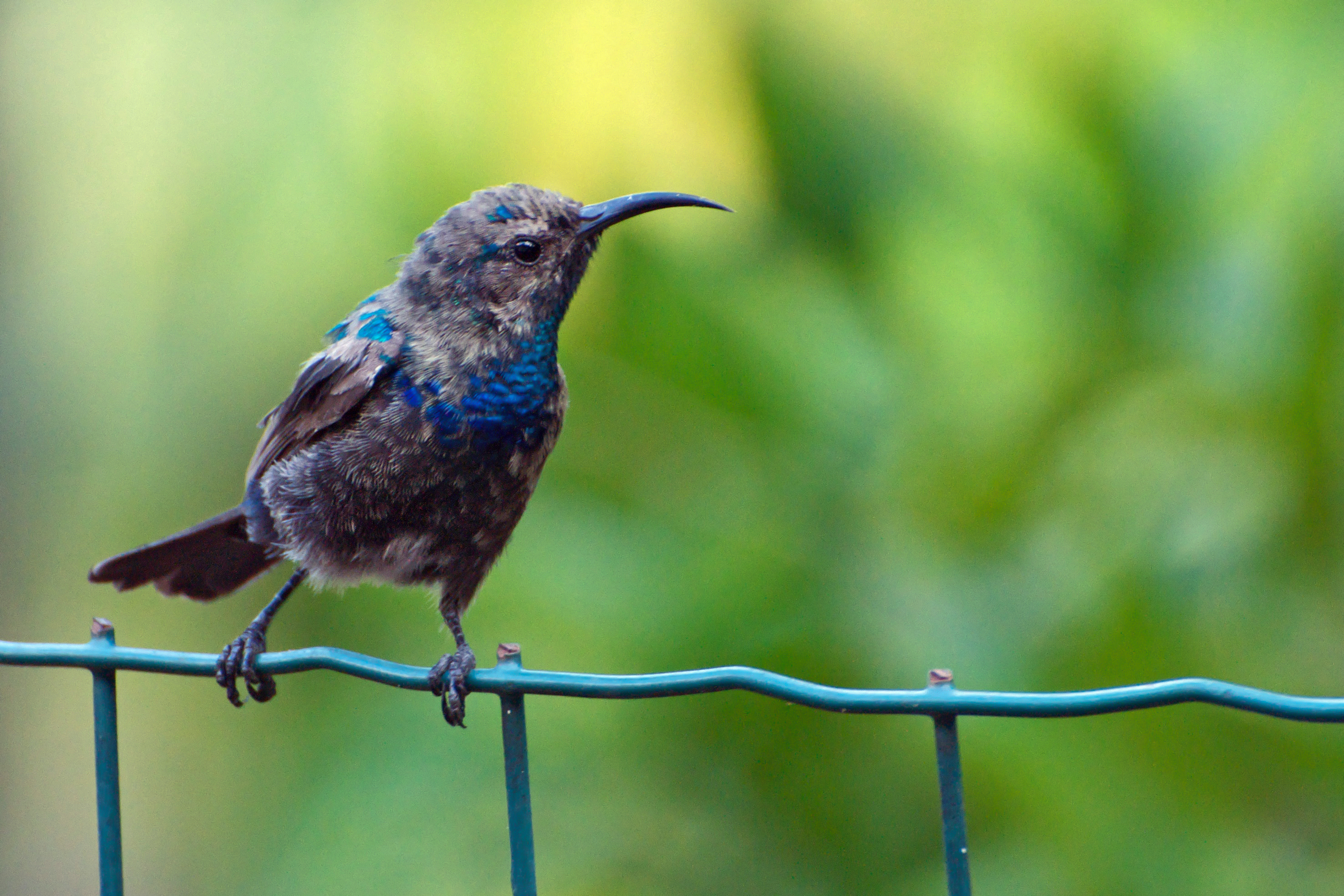
What the Palestine sunbird represents
This meaning grows directly out of how the bird lives.
1. Rootedness in the land. The sunbird is native to Palestine and lives there year round rather than migrating away for the season. It feeds on flowers that have grown in these valleys for thousands of years. For a people whose relationship to the land sits at the center of their identity, a bird that simply stays carries obvious weight.
2. Resilience. The species is listed as Least Concern on the IUCN Red List, and it adapts easily to gardens and cultivated ground. It is small, but it is not fragile. That mix of soft form and tough survival is a large part of its appeal as a symbol.
3. Beauty that cannot be dulled. The male's iridescence is not pigment. It is structural color, produced by the way light bends through the microscopic layers of each feather. It cannot be washed out or painted over. As an image of a heritage that keeps its brilliance under pressure, it is hard to improve on.
4. A national emblem. In 2015, the Palestinian Authority adopted the Palestine sunbird as a national bird, formalizing an association many Palestinians already felt. The bird now appears in Palestinian art, jewelry, and design as a compact stand-in for the land itself.
How the sunbird became a national symbol
The sunbird's path to national status is worth telling plainly. The species is native across the region, and in 2008 it featured in a widely publicized public vote in Israel to choose a national bird, a contest the hoopoe ultimately won. Several years later, in 2015, the Palestinian Authority adopted the Palestine sunbird as a national bird of Palestine.
The choice fit. Unlike a borrowed or invented emblem, the sunbird was already there, in the orchards and gardens, familiar to anyone who had spent time outdoors. Naming it did not create a symbol so much as recognize one. The bird described by ornithologists as the Palestine sunbird, Cinnyris osea, had been part of Palestinian life long before it became part of Palestinian iconography.
The sunbird in art and memory
Birds have never been far from the Palestinian imagination. Mahmoud Darwish, the Palestinian national poet who was born in 1941 in the village of al-Birwa and died in 2008, returned throughout his work to images of birds, wings, and flight as figures for exile, longing, and the hope of return. He wrote no single defining poem about the sunbird, but the instinct he gave voice to, reading the natural world as a language for belonging, is what makes this small bird resonate.
The sunbird sits comfortably within that wider vocabulary of Palestinian symbols. It belongs with the Palestinian olive tree and its roots of resilience and endurance, and with the native flowers of Palestine and their place in the region's history, the very blossoms the bird feeds on. Its iridescent blues and greens even echo, softly, the colors and meaning of the Palestinian flag. Together these symbols form a way of speaking about home without raising a voice.
Frequently asked questions about the Palestinian sunbird
Is the Palestine sunbird the national bird of Palestine?
The Palestine sunbird has been widely described as the national bird of Palestine. In 2015, the Palestinian Authority adopted the species as a national bird. The bird is native to the region and had earlier featured in a 2008 public vote in Israel to choose a national bird, a contest the hoopoe won.
What does the Palestinian sunbird look like?
The breeding male is a small bird, roughly 8 to 12 centimeters long, with glossy iridescent blue and green plumage and orange feather tufts at the sides of the breast. The female and non-breeding male are grey-brown above with paler underparts. Both have a long, slender, downward-curving black bill.
What does the Palestine sunbird eat?
The Palestine sunbird feeds mainly on nectar and small insects. It has a long, brush-tipped tongue and a slender curved bill suited to reaching into flowers, and it helps pollinate the plants it visits as it moves between blossoms.
Why is the sunbird a symbol for Palestinians?
The sunbird is native to the land of Palestine and lives there year round rather than migrating away. Its small size, resilience, and bright plumage have made it a quiet emblem of rootedness, endurance, and belonging, appearing in Palestinian art, jewelry, and design.
A small bird that stays
The Palestinian sunbird is not just a bird; it's a small, living claim to a place. It was here before the borders were drawn, it feeds on flowers that have grown in these valleys for millennia, and it stays through every season while so much else is forced to move. To watch it flash blue and green in an orchard is to see something rooted, brilliant, and quietly impossible to displace.

At FALASTIN, we aim to keep that heritage alive through our Symbols of Palestine collection.
100% of profits from FALASTIN are donated to the United Palestinian Appeal.